
01Threshold crossed
Filing metric
Gross margin
Gross margin moves from 45.0% to 42.8%.
45.0%42.8%−2.2%
Q2 earnings filing · page 34
Investment thesis monitoring for fundamental investors
You bought the stock for a reason. Ntree checks every filing, transcript, and headline against that exact reason — and tells you when one of your assumptions stops being true.
Primary sources
From disclosure to decision
Ntree watches the condition behind your thesis, connects the evidence, and gives you time to review it before the signal becomes consensus.
Filing metric
Gross margin moves from 45.0% to 42.8%.
Q2 earnings filing · page 34
Live thesis · NVDA
MonitoringCondition
Source evidence“Gross margin was 42.8%, reflecting lower product mix...”
Q2 earnings filing · p. 34
Price reaction
How it works
Set it up once. Ntree keeps checking the sources while you get on with everything else.
Plain English, the way you'd explain the position to a colleague. No query syntax, no rule builder.
“I own this because services gross margin is durable above 38%, and the Monterrey facility is on track to ship by Q4 FY27.”
The specific, checkable facts that would prove you wrong.
With the sentence that triggered it, the document it came from, and a link straight to the source.
“Gross margin was 37.4%, down from 38.2% in the prior quarter.”
What you get
Live thesis tracking, continuous coverage, source-linked alerts, and one clear portfolio view.
Swipe to explore
01
Your reasoning, conditions, and status—updated as the facts change.
Services margin stays above 38%
02
Filings, calls, and news checked the moment they publish.
03
Every alert includes the exact sentence and its primary source.
! Threshold crossed
“Gross margin was 37.4%, down from 38.2%.”
04
Every holding and thesis status, together on one screen.
Daily brief
Ntree reads the day's coverage across every name you hold and returns one short brief — what moved, which thesis it bears on, and whether any of it needs you.
Only the names in your portfolio. No market-wide firehose, no “top stories” you scrolled past this morning.
Each summary says which assumption it bears on — not just which ticker it happened to mention.
Every line links to the article or filing it came from, so you can read the original whenever the summary is not enough.
Your morning brief
4 holdings · 11 stories read · 3 worth your time
Hyperscaler capex guidance raised again for the second half of the year.
Supports · AI demand is durable through FY27
Second domestic competitor announces a High-NA equivalent on a 2028 timeline.
Tests · EUV monopoly underpins pricing power
New retail format opens in three additional cities.
No bearing on your thesis
Why Ntree
None of them know what you believe about the company. Ntree starts from your thesis and works backward — so the only thing it surfaces is evidence about the specific claims you made.
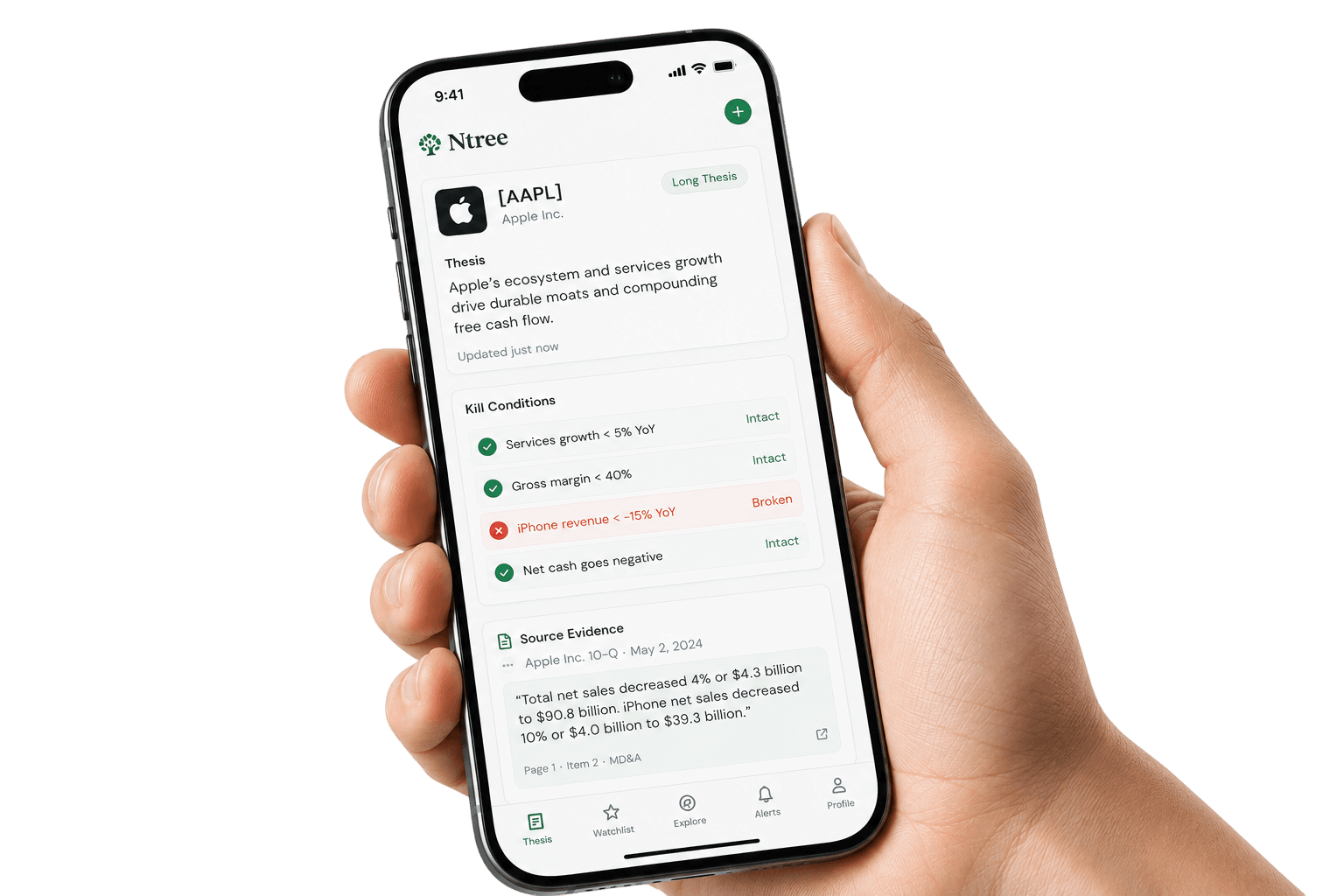
Kill conditions
2 of 3 intact
Services revenue grows at least 12% YoY through FY26
Active installed base expands in every reported quarter
Gross margin falls below 38% for two consecutive quarters
Triggering evidence
“Gross margin for the quarter was 37.4%, down from 38.2% in the prior quarter and 39.1% in the year-ago quarter.”
FAQ
The things people ask before they trust a tool with their research.
SEC EDGAR filings, earnings-call transcripts, and licensed news feeds. Every alert names its source document.
No. You define the conditions. Ntree finds evidence that bears on them and shows you the source. The judgment stays yours.
Alerts are anchored to retrieved source text. If there's no source sentence, there's no alert.
US-listed equities first. More coverage after that.
Individual investors, analysts, and small funds who hold concentrated positions long enough for the thesis to matter.
No. Ntree surfaces primary-source evidence about assumptions you defined. It does not recommend, rate, or rank securities.
Ntree is in early access. Leave your email and we'll get in touch when it's ready.
One email when we launch. No newsletter, no sharing your address. Prefer to write first? hello@ntree.io